

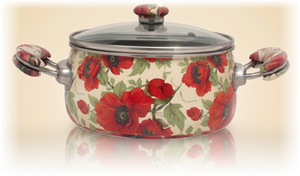

What is EOS? (Enamel On Steel) — A Guide to Steel Enamel
EOS stands for Enamel On Steel. It is the smooth, glassy surface on the body of every Eternity pot, and it is what decides both how long a pan lasts and how safe it is to cook in.
What is steel enamel (EOS 800°)?
Steel enamel (EOS 800°) is material made of mild carbon steel with good thermal conductivity, coated with enamel.
Heat efficiency and functionality are the most basic properties of steel enamel: a thin glass layer is applied to the metal under high temperature to protect it against corrosion.
Enamel is therefore not a paint or a plastic coating. It is a mineral layer, molten glass fused onto the steel itself. Our enamel coating page describes the surface in detail.
How it is made
Production starts with the steel sheet that gives the pot its shape; the surface is then cleaned and the enamel slip applied.
- Carbon steel sheet is cut and pressed into the form of a pot, pan or casserole.
- The body is degreased and de-scaled, leaving a clean surface for the enamel to bond to.
- An enamel slip of glass frit, clay and mineral oxides is sprayed onto the inside and the outside.
- It is fired at about 800°C. At that temperature the glass melts and bonds chemically with the steel.
- Colour and decoration coats repeat the process; every coat is fired again.
This is the point at which the coating is fused to the steel rather than stuck onto it. You can see the line in our factory on the manufacturing page.
What does 800° mean?
The temperature the enamel is fired at also sets the temperature the finished pot will take. A surface fired at 800°C is used to thermal stress far beyond oven heat, so the hob, the oven and even embers are no trouble.
Eternity's PRO 800° series is named after that firing temperature.
How our products come through oven, thermal-shock and scratch testing is on the durability testing page.
Enamel, porcelain and granite — the same thing?
The three words belong to one family but they are not interchangeable:
- Enamel (EOS): a glass layer fired onto steel. Odourless, non-porous, good to 800°C.
- Porcelain enamel: the same technology named for a higher grade of raw material; marketing often uses the two terms for one another.
- Granite-look coating: not enamel at all, but a non-stick coating speckled with mineral particles. In our EN GRANIT series it too is applied over a steel body.
Which of our products are steel enamel?
Eternity's pots, casseroles, tea pots and storage containers all have steel enamel bodies. The Otantik Emaye, Gardenia and PRO 800° series are the same technique in different finishes and handles.
Frequently asked questions
What does EOS stand for?
Enamel On Steel. The 800° that follows it is the temperature the enamel is fired at.
Is steel enamel healthy?
Enamel is a glassy, non-porous surface: food never touches the metal and no taste or smell carries over. As long as the coating is sound it is safe for cooking, marinating and serving.
Can enamel pots be used on induction?
Yes. The body is carbon steel and therefore magnetic, so enamel pots work on every hob including induction.
Does enamel scratch?
The glass surface resists scratching better than most metals, but a hard knock can chip it. Avoid banging metal cutlery against the rim and heating an empty pot on a high flame.