

Durability testing


Eternity is a brand of Güzeliş Porselen.
Durability testing
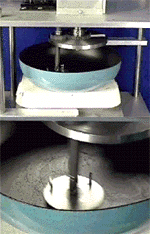
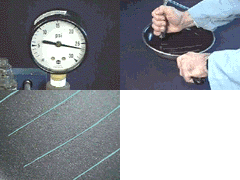
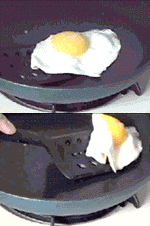
Eternity's performance has been tested within a broad scientific research programme.
Non-stick surface tests
- In the first test, pans were immersed in oil heated to 200 °C for 24 hours. No part of the non-stick or enamel surfaces of Eternity products was damaged.
- In the second test, milk and egg were cooked in the pan with no lubricating agent whatsoever. The surface showed excellent non-stick behaviour and cleaned easily.
- The surface was then scored with a knife at 2 mm intervals; after adhesive tape was applied and pulled away, no part of the non-stick surface lifted. This test was repeated 25 times.
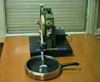
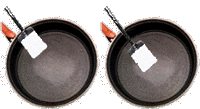
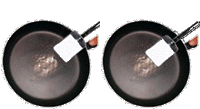
- After 60,000 spatula scrapes the Eternity pan retained its non-stick properties; the competitor pan tested alongside it lost them after 3,000.
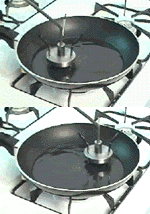
- SCRAPE TEST: the surface of the pan was rubbed with a metal spatula, imitating the motion of cooking an omelette. After 60,000 cycles Eternity still showed excellent non-stick behaviour. At various shows this figure has exceeded 200,000 cycles.
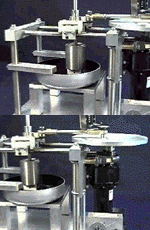
- ABRASION TEST: carried out by scouring the wet non-stick surface with a cleaning implement. On Eternity products, surface wear appears only after 1,800 repetitions.
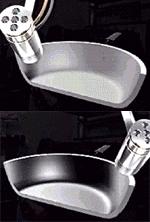
- CUTTING TEST: the surface was scored with a crescent-shaped carbide cutter. The force required to pierce Eternity's base was found to be 26 newtons, beyond which the base was damaged.
- STAIN RESISTANCE TEST: conventional non-stick coatings are prone to staining, particularly in light colours. In this test an Eternity roasting tray was held at 315 °C for 36 hours, and retained its resistance to both high heat and staining throughout.
The tests show that Eternity is up to 20 times more durable.